100+ Product Manager Interview Questions with Answers (by Round, Role and Company)

October 30, 2026

A product manager interview can start with a simple question: “Tell me about a product you love.” Ten minutes later, you might be prioritising a backlog, estimating a market or explaining why a product’s growth suddenly slowed.

If you’re preparing for one, especially as a fresher, it can feel overwhelming. There are hundreds of product manager interview questions online, several frameworks to learn and very little clarity about what interviewers actually want to hear. The good news is that you don’t need to memorise hundreds of answers.

You need to learn how to approach a problem, explain your reasoning and make a decision with the information you have.

This guide gives you product manager interview questions with example answers, organised three ways: by round (what each stage tests), by role (APM, product owner, product analyst, technical PM and agile PM) and by Indian company. There are more than 100 questions, and every case-type question links to a solved case study. At the end, you can download the question bank.

Here’s the best way to use it. Pick the round you’re about to face and answer each question out loud before you read the pointer. Reading answers feels like progress, but saying them is what prepares you for a real pm interview.

How PM interviews are structured: the rounds

Most hiring processes for product manager roles in India have four to six steps. Formats vary from company to company, so treat the table below as typical, not guaranteed. For the full process and a week-by-week schedule, read our guide on how to prepare for a PM interview. If you have a portfolio, mention it early. These product manager portfolio examples show how to present one.

Round What it tests Typical length How to prepare
Recruiter screen A clear story, why PM, basic fit such as notice period and expected pay 20 to 30 minutes Tailor your resume using product manager resume keywords and rehearse a 60-second story
Product sense and design Understanding users, choosing problems, trade-offs 45 to 60 minutes Use CIRCLES on design prompts
Case study Structure, estimation logic, narrowing down causes 30 to 60 minutes Use a framework for each case type
Analytics and metrics Choosing metrics, guardrails, experiments 30 to 45 minutes Use GAME on metrics prompts
Behavioural Ownership, teamwork, handling conflict, results 45 to 60 minutes Build a bank of STAR stories
Leadership Strategy, judgement, how you lead others 45 to 60 minutes Prepare senior-level prompts and your own point of view

Some companies add a technical or domain round, especially for technical PM and analyst roles. Ask your recruiter what the process includes instead of assuming. If you’re a fresher, college projects, internships and team assignments all make good examples.

10 most common product manager interview questions, with example answers

These are the common product manager interview questions that show up, in some form, in most processes. Each has what the interviewer is testing and an example answer. The numbers are made up, so use your own real story.

1) Tell me about yourself

What the interviewer is testing: whether you can tell a clear, short story and link it to this role.

Example answer: “I’m a software engineer with three years in fintech. Over time I found myself spending more time on what we were building than how. I started joining customer calls and wrote the spec for our refund flow, which cut support tickets by 20%. That’s why I’m moving into product, and why this role, which owns a payments journey, is a natural next step.”

2) Tell me about a product you love and how you would improve it

What the interviewer is testing: whether you understand users and can pick one thing to fix.

Example answer: “I use a food delivery app daily. I’d focus on people ordering for a family at the weekend, because their orders are large and mistakes are costly. Their problem is that they can’t tell early whether a restaurant has enough stock for the whole order. I’d show a low-availability warning before checkout and measure fewer cancelled orders.”

3) Tell me about a time you used data to change a decision

What the interviewer is testing: whether you let evidence beat opinion, and whether you can explain a result.

Example answer (STAR): “Our signup completion was stuck at 38% (situation). I owned fixing it (task). The plan was to add a tutorial, but the funnel showed most people dropped at phone verification, so I proposed moving verification to later in the flow (action). Completion rose from 38% to 61% in two months, and we dropped the tutorial (result).” A real number makes the story believable.

4) How do you prioritise a backlog?

What the interviewer is testing: whether you have a method and know its limits.

Example answer: “I start with a simple score such as RICE (reach, impact, confidence, effort) to get a first ranking. Then I adjust for strategy and dependencies, because a low-scoring item that unblocks a big launch can jump the queue. The trade-off is that scores can look more precise than they are, so I use them to start the discussion, not to end it.”

5) Tell me about a product you shipped from idea to release

What the interviewer is testing: whether you understand the full cycle, not just one stage.

Example answer: “We noticed that new users abandoned our wallet top-up. I interviewed ten users, found they didn’t trust the payment screen, and we tested a version with clearer security cues. We launched it to 10% of users first, saw top-ups rise by 12%, then rolled it out fully.”

6) Tell me about a disagreement with an engineer or designer

What the interviewer is testing: whether you can disagree without ego and still move forward.

Example answer: “An engineer said a feature would take six weeks. Instead of arguing, I asked what drove the estimate. One custom screen accounted for most of it. We shipped a simpler version in two weeks, tested it, and kept the custom screen on the backlog.”

7) How do you decide what not to build?

What the interviewer is testing: focus. Strong PMs say no for reasons.

Example answer: “I tie every request to the goal for the quarter. If an idea doesn’t move that goal, or costs far more than it returns, it waits. I tell the requester why and what would change my mind, so a ‘no’ becomes ‘not now, and here’s what we’d need to see.’”

8) How would you measure the success of a new feature?

What the interviewer is testing: whether your metric matches your goal and you protect against side effects.

Example answer: “First the goal: what is this feature for? Then the action users would take if it worked, then one main metric that captures it, plus a guardrail so we don’t hurt something else. I’d run an A/B test and check that the result holds after a few weeks.” The GAME framework below turns this into a repeatable answer.

9) Tell me about a time you failed

What the interviewer is testing: honesty and learning, not perfection.

Example answer: “We launched an update without testing on low-end phones, and crash rates doubled. I rolled it back within two days, told leadership what happened, and added a device-testing step to our release checklist.” Own the mistake, say what you did, and show what changed.

10) How do you handle stakeholders who want conflicting things?

What the interviewer is testing: whether you can align people without authority.

Example answer: “Sales wanted a new report, support wanted a bug fixed. I put both against our quarterly goal and the data: the bug affected 8% of users, the report one large customer. I fixed the bug first, shipped a lighter version of the report, and explained the reasoning to both teams in writing.”

Product sense and product design questions

These test whether you understand people before you propose anything. Use the CIRCLES method (below) and practise with our product design case studies.

  1. Design an alarm clock for deaf users
    Choose one user, name their real problem (waking up without sound), then compare options such as vibration and light.
  2. Design a way for office teams to order lunch together.
    Pick one user, such as the team admin, and one problem, such as collecting orders and payments.
  3. How would you improve Instagram Reels?
    Choose one user group and one problem. Don’t list features.
  4. Design a savings app for first-time earners.
    Ask what “first-time earner” means, then pick one situation, such as a first salary.
  5. How would you improve the experience of booking a train ticket?
    Choose a user (a daily commuter or a once-a-year traveller) before choosing fixes.
  6. Design a product that helps older people stay in touch with family.
    Start with their real barriers: comfort with technology, eyesight, and who they want to reach.
  7. Design a mobile app for filing income tax returns.
    Find the biggest fear, which is usually making a mistake, and design around trust.
  8. What is your favourite product, and why?
    Explain who it’s for, the problem it solves and one thing you’d change.
  9. How would you design a product for people learning to cook?
    Choose a learner, such as a student living alone, and the one thing that stops them.
  10. Pick a product you think is bad. How would you fix it?
    Be specific about who it fails and why. Fix one thing, not everything.
  11. How would you improve Google Maps for people who walk?
    Choose one walker (a tourist or a daily commuter) and one problem.

Case study, guesstimate and RCA questions

Case rounds are a family of problems: estimate a number, find why a number dropped, or improve a product. Name the type in the first ten seconds. Our product manager case study interview guide covers all five types in depth. For more, browse our guesstimate questions with answers and RCA case studies.

  1. How many petrol stations are there in Mumbai?
    Go top-down from the city’s population and vehicles, then cross-check bottom-up from one station’s daily capacity.
  2. How many cups of tea are sold in Delhi each morning?
    Population, share who buy tea outside, cups per person. Cross-check bottom-up from one stall.
  3. Estimate the number of Ola rides in Bangalore each day.
    Choose a route, state each assumption out loud and sanity-check the answer.
  4. Rapido’s rider rating dropped 10%. Why?
    Check how the rating is measured first, then split by riders, drivers and trip type.
  5. Urban Company’s service completion rate fell 18% in Bengaluru. Where do you start?
    Clarify the metric, find the stage in the journey, then cut by segment before naming causes.
  6. Paytm’s monthly active users fell 25%. What do you do?
    Find where the drop sits (new or returning users, platform, city) before guessing why.
  7. How would you improve Swiggy for late-night orders?
    Choose which part to improve, and for whom, before suggesting fixes.

Metrics and analytics questions

Start with the goal, then the action, then the metric and a guardrail. For solved examples, practise with our metrics case studies.

  1. How would you measure the success of YouTube’s recommendations?
    Pick one main metric (such as the share of recommended videos watched through) and a guardrail (such as dislikes). Watch time alone can mislead.
  2. Which metric matters most for Netflix’s “My List” feature?
    Tie it to the goal: helping people find something to watch later.
  3. How would you measure a new one-tap reorder feature?
    Share of repeat orders placed with one tap, with cancellations as the guardrail.
  4. What is the most important metric for Tinder’s swipe feature?
    Link it to the goal of meaningful matches, not swipes.
  5. What KPIs would you track for Uber’s ride-sharing?
    Separate rider, driver and marketplace health. Don’t list ten.
  6. Daily active users fell, but time spent per user rose. What’s going on?
    Look for a drop in casual users and a loyal core. Segment before concluding.
  7. An A/B test shows a 3% lift. Do you launch?
    Ask about sample size, how long it ran, side effects and whether the lift holds over time.
  8. What would you track for a new subscription plan?
    Sign-ups, renewals and cancellations, plus whether free users upgrade without hurting the free experience.
  9. What would you track for a new UPI payments feature?
    Success rate, speed and drop-off at each step, with failed-payment complaints as the guardrail.
  10. How would you know if a new feature is taking users away from an existing one?
    Compare usage of both, and check whether total engagement actually grew.

Behavioural questions (STAR)

Answer these with STAR: situation, task, action and result, spending most of your time on the last two. Have six stories ready that can flex across these prompts.

  1. Tell me about a time you disagreed with your manager.
    Show that you disagreed respectfully, used evidence, and committed once a decision was made.
  2. Describe a time you influenced people without authority.
    Name who you needed, why they cared and how you convinced them.
  3. Tell me about a launch that didn’t go as planned.
    Own it, say what you did in the first 48 hours and what changed afterwards.
  4. Describe a project with a very tight deadline.
    Show what you cut, who you told and how you protected quality.
  5. Tell me about customer feedback that changed your plan.
    Say what you heard, what you changed and the result.
  6. Tell me about a mistake you made and how you fixed it.
    Honest, specific and short, with a change in how you work.
  7. Describe a difficult teammate and how you worked with them.
    Focus on the problem you solved together, not on blame.
  8. Tell me about a time you took ownership without being asked.
    Show initiative with a clear result.
  9. What is your biggest professional achievement?
    Pick one with a number, and explain your personal contribution.
  10. Tell me about a time you said no to a senior leader.
    Show the evidence you used and how you kept the relationship.

Strategy and leadership questions

These are common product manager interview questions and answers for experienced candidates, and for anyone interviewing for a senior role.

  1. How would you set the product strategy for a product whose growth has slowed?
    Diagnose first (acquisition, activation or retention), then choose one bet and say what you’d stop doing.
  2. How do you decide whether to build, buy or partner?
    Compare speed, cost, control and how central the capability is to your advantage.
  3. How would you take a product into tier-2 cities?
    Start with what changes for the user: language, price, trust, payments and delivery. Then choose the first city and why.
  4. How do you build a roadmap with competing demands from sales, engineering and leadership?
    Anchor on one goal, make trade-offs visible and share the logic.
  5. Tell me about a time you coached someone on your team.
    Show how you diagnosed their gap and what changed.
  6. How do you handle an underperforming team member?
    Clear expectations, early feedback, support, and a fair decision if nothing changes.
  7. How would you decide to shut down a feature?
    Look at usage, cost, strategic fit and who would be affected, and plan how to tell them.
  8. How would you decide which market to enter first?
    Compare market size, how ready your product is and what you’d need to win.
  9. How would you balance growth against profitability?
    Say which matters more at this stage and what you’d protect.

Interview questions by role

These roles overlap with product management but are tested differently.

Associate product manager (APM) interview questions

If you’re looking for associate product manager interview questions, or product manager interview questions for freshers, expect more product sense, estimation and metrics than questions about shipped products. Interviewers look for clear thinking and signs that you’ve practised.

  1. Why do you want to be an APM?
    Link something you’ve done, like a project, to what the job involves.
  2. Tell me about a product you built, even a college project.
    Problem, users, what you built and what happened.
  3. Design a campus app for hostel students.
    Pick one student, one problem.
  4. How many auto-rickshaws are there in Pune?
    State assumptions and cross-check.
  5. How would you measure the success of a new student discount feature?
    Goal, action, metric, guardrail.
  6. Tell me about a time you worked in a team and it was hard.
    Use STAR with a specific result.

Product owner interview questions

Product owner interview questions focus on the backlog, the sprint and working with stakeholders.

  1. How do you write a good user story?
    Who, what and why, with clear acceptance criteria.
  2. How do you decide when a story is ready for a sprint?
    It’s small, clear, testable and understood by the team.
  3. How do you groom and prioritise a backlog?
    Name a method and a trade-off.
  4. What’s the difference between a product owner and a product manager?
    Owner of the backlog and sprint outcomes versus owner of the wider product strategy.
  5. A stakeholder wants a change mid-sprint. What do you do?
    Protect the sprint goal, estimate the impact and decide whether it waits.
  6. What does “done” mean for your team?
    A shared checklist covering testing, review and release.

Product analyst interview questions

Product analyst interview questions test whether you can find the answer in the data and explain it simply. Expect SQL, metrics and experiment design.

  1. A key metric dropped 10% this week. How do you investigate?
    Check the metric definition, then segment by time, platform, country and user type.
  2. How would you design an A/B test for a new checkout button?
    Hypothesis, metric, sample size, duration and guardrails.
  3. Write a query to find the top three products by revenue in each category.
    Describe the approach: group by category, rank by revenue, keep the top three.
  4. What does “statistically significant” mean, in plain words?
    The result is unlikely to be just chance.
  5. When would you use the median instead of the average?
    When a few extreme values would distort the picture.
  6. How would you measure the impact of a change you can’t A/B test?
    Compare before and after, use a similar group as a control and say what could still mislead you.
  7. How would you explain a finding to a non-technical team?
    Lead with the decision, then one chart.

Technical product manager interview questions

Technical product manager interview questions test whether you can work with engineers on design choices and explain trade-offs. You don’t need to write the code. You need to understand what it costs.

  1. Explain an API to someone who isn’t technical.
    A waiter taking your order to the kitchen and bringing back the food.
  2. How do you decide between building and buying a technical capability?
    Speed, cost, control and how central it is to your product.
  3. What is technical debt, and when is it worth taking on?
    Shortcuts that speed up today and slow down tomorrow. Worth it when speed matters and you plan to repay.
  4. How do you work with engineers on estimates?
    Ask what drives the estimate, and break the work into smaller parts.
  5. How would you design a notification system at a high level?
    Triggers, delivery channels, user controls, limits and failure handling.
  6. What trade-offs come with releasing faster?
    Speed versus quality and risk. Say how you’d reduce the risk.

Agile / Scrum product manager interview questions

Agile product manager interview questions check whether you can run discovery and delivery together without losing focus.

  1. Walk me through a sprint from start to finish.
    Planning, daily check-ins, review and retrospective.
  2. How do you handle changing priorities mid-sprint?
    Protect the goal, swap work rather than add it.
  3. What’s the difference between velocity and outcomes?
    Velocity is how much the team delivers; outcomes are what changed for users.
  4. How do you split a large feature into stories?
    Slice by user value, not by technical layer.
  5. When would you choose Kanban over Scrum?
    When work arrives unpredictably and flows continuously.
  6. How do you run a retrospective that leads to change?
    Pick one action, assign an owner, review it next time.

PM interview questions asked at Indian companies

Looking for product manager interview questions India companies ask? Here’s the honest version. Companies don’t publish their questions, and lists copied from forums are often old or wrong. So this section gives patterns based on what each business does, plus practice prompts from our case library. They’re practice material, not reported interview questions. If you’ve interviewed at one of these companies, tell the community and we’ll update this page. Browsing live roles? See our product management jobs board.

Flipkart

Flipkart product manager interview questions are likely to lean on e-commerce scale and festive-season spikes.

1. What’s the total value of electronics sold on Flipkart during the festive season? A TPF practice case.

2. How would you improve Flipkart for small businesses? A TPF practice case.

3. Orders slowed on a big sale day. How do you find out why? Practice prompt: use the funnel-first method to identify where the drop occurred. Practise with TPF's Root Cause Analysis Case Studies.

Swiggy and Zomato

Swiggy product manager interview questions and Zomato product manager interview questions tend to revolve around a three-sided marketplace of customers, restaurants and delivery partners. Check all three sides in every answer.

1. How many meals does Swiggy deliver in Mumbai each day? A TPF practice case.

2. Swiggy orders dropped 30% in Bangalore. Why? A TPF practice case.

3. Zomato’s average restaurant rating fell 10% in Pune. What happened? A TPF practice case.

4. How can Swiggy improve delivery services? A TPF practice case.

Razorpay and CRED

Razorpay product manager interview questions are likely to centre on payments: transactions, success rates and trust. For CRED product manager interview questions, these are practice prompts based on the business.

1. Estimate the value of transactions Razorpay processes in a day. A TPF practice case.

2. How would you measure a new rewards feature for a bill-payment app? Read TPF's discussion of CRED rewards and metrics.

3. How would you improve the bill-payment experience for a card holder? Read TPF's discussion of CRED's credit-card payment and management experience.

Google and Microsoft India

Google product manager interview questions and Microsoft product manager interview questions are widely discussed online, but not every question is verified. Both companies have published interview guidance on their careers sites, so start there. For practice, use these TPF case studies.

1. How would you design Google Home Mini for blind users? A TPF practice case.

2. What metrics would you use for Google Search? A TPF practice case.

3. How would you measure the success of Google Maps’ route planning? A TPF practice case.

Frameworks to structure your answers

Three frameworks cover most questions. Treat them as scaffolds, not scripts.

CIRCLES for product design questions

CIRCLES helps you answer questions like “How would you improve Instagram?” in a structured way.
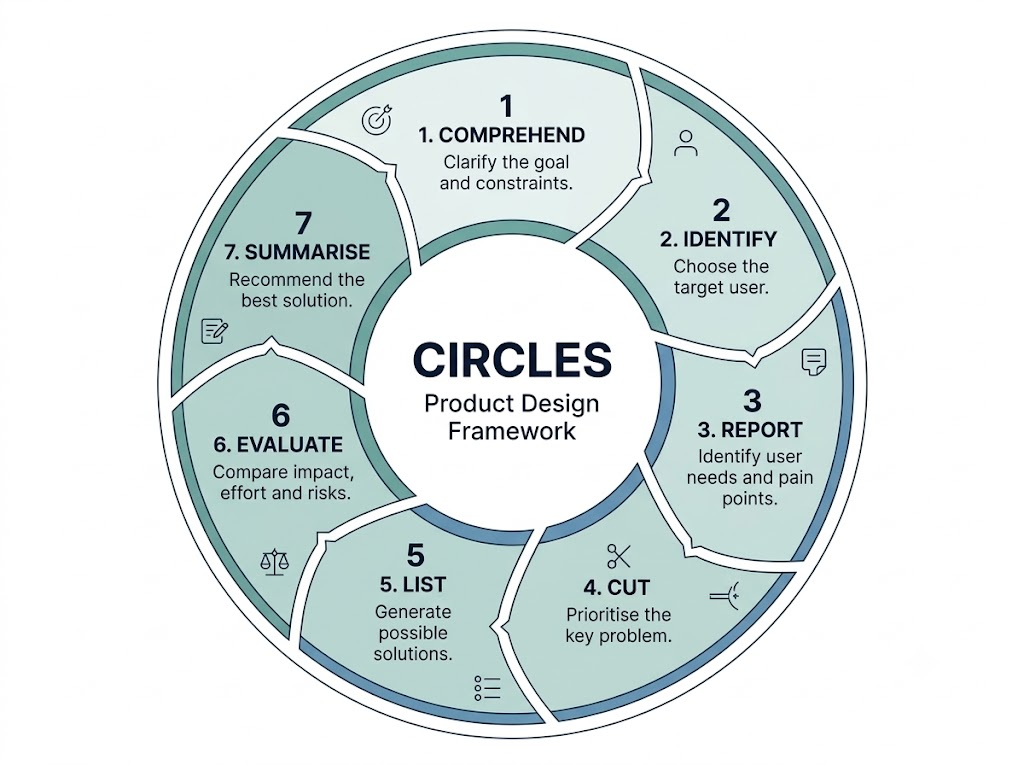
CIRCLES framework for product design questions: Comprehend, Identify, Report, Cut, List, Evaluate, Summarise
  • Comprehend the situation: Understand the goal and constraints.
  • Identify the customer: Decide which user group you’re solving for.
  • Report customer needs: Identify the users’ main problems.
  • Cut through prioritisation: Choose the most important problem to solve.
  • List solutions: Brainstorm possible solutions.
  • Evaluate trade-offs: Compare solutions based on impact, effort and risks.
  • Summarise: Recommend your solution and explain how you’ll measure success.

When to use it: For product design and improvement questions. Focus on solving the user's problem rather than simply naming each step.

STAR for behavioural questions

STAR helps you answer questions about your past experiences, such as “Tell me about a time you handled a challenge.”
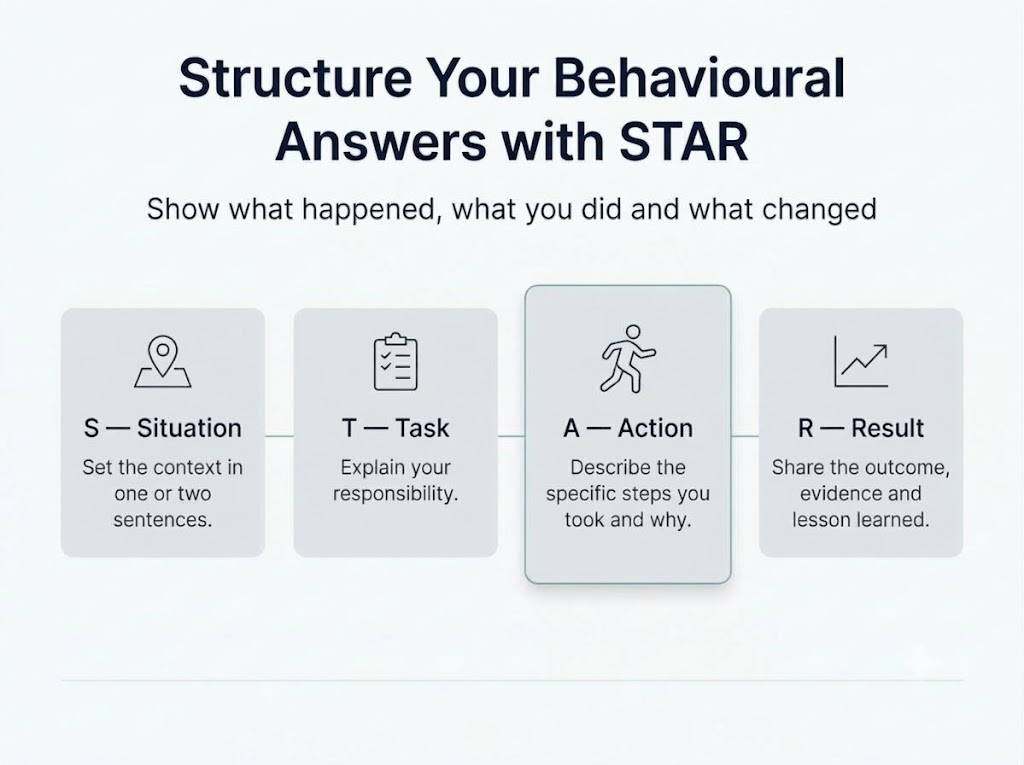
STAR framework for behavioural questions: Situation, Task, Action, Result
  • Situation: What was happening?
  • Task: What were you responsible for?
  • Action: What did you do?
  • Result: What happened because of your actions?

Example: “During a checkout launch, payment failures for one bank increased by 15% (Situation). I was responsible for the launch (Task). I paused the rollout, worked with engineering to fix the issue and kept stakeholders informed (Action). We relaunched gradually, and payment failures fell below their previous level (Result).”

The numbers are illustrative.

When to use it: For questions about teamwork, leadership, conflict, failure or problem-solving. Spend the most time explaining your actions and results.

GAME for metrics questions

GAME is a four-step framework used by TPF to structure metrics answers: Goal, Action, Metric, Evaluate.
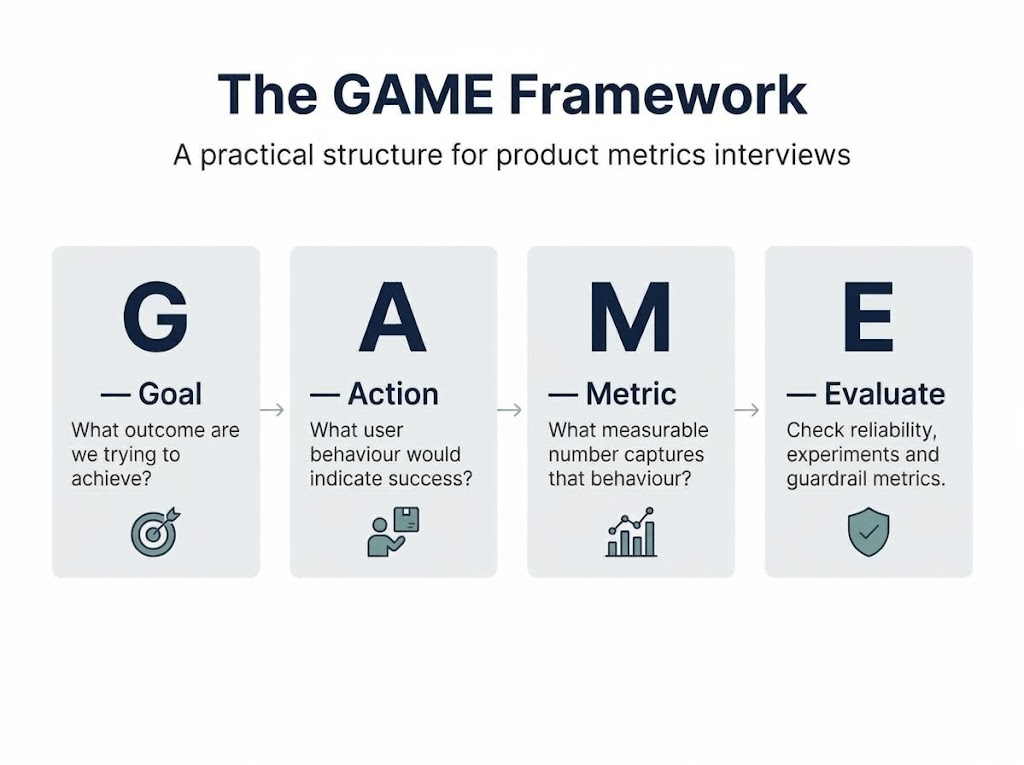
GAME framework for metrics questions: Goal, Action, Metric, Evaluate
  • Goal: What outcome are you trying to achieve?
  • Action: What user behaviour would show that the product is working?
  • Metric: Which metric would measure that behaviour?
  • Evaluate: How will you test the impact and check for unintended consequences?

Example: “How would you measure a one-tap reorder feature?”

  • Goal: Make repeat ordering easier.
  • Action: Help users reorder without rebuilding their carts.
  • Metric: Percentage of repeat orders placed using one-tap reorder.
  • Evaluate: Run an A/B test and monitor cancellations and customer ratings to ensure convenience isn't increasing accidental orders.

When to use it: For questions about product success, feature performance, growth or engagement. Always connect your metric to the product goal and include guardrail metrics to catch negative effects.

Questions you should ask the interviewer

Good questions show curiosity and help you decide whether the job is right for you. Pick four or five.

  1. What does success look like in this role after six months?
    It tells you how you’ll be measured.
  2. How does the team decide what to build, and who makes the final call?
    It shows how much ownership PMs have.
  3. How do product, design and engineering work together day to day?
    It reveals the real working culture.
  4. What is the biggest challenge facing this product right now?
    It shows what you’d actually be solving.
  5. How do you measure the product’s success?
    It shows whether the team is outcome-focused.
  6. Tell me about a feature that didn’t work. What happened afterwards?
    It shows how the team handles failure.
  7. How are PMs evaluated here, and what does growth look like?
    It reveals the career path.
  8. How is pay structured for this role?
    Ask this at the offer stage, or when the recruiter raises it, and check market benchmarks first.

Download the PM interview question bank

Get the 100+ PM interview questions PDF, grouped by round and role, with answer pointers and a CIRCLES, STAR and GAME cheat sheet. Practise weekly with three product questions, two analytical cases and two behavioural questions.

Download the PM interview question bank (PDF)

FAQs

What are the most common product manager interview questions?

Common questions cover introducing yourself, improving a product, prioritising features, using data, handling disagreements, measuring success, learning from failure and managing stakeholders.

How do I answer “Why product management”?

Explain what sparked your interest, what you enjoy about product work, and why this role fits your goals.

What questions are asked in an APM interview?

Expect product design, estimation, metrics, project discussions and questions about why you want to become a PM. Freshers are often evaluated on their problem-solving approach.

How many rounds are there in a PM interview in India?

Typically, four to six rounds covering recruiter screening, product sense, cases, metrics and behavioural questions. The process varies by company. See our product manager interview preparation guide for details.

blogs

Break into

Product Management

Benefit from our wide pool of initiatives to give you a starting point to begin your product management journey
October 30, 2026

Product Manager Interview Preparation: Rounds, Frameworks and a 30-Day Plan

A round-by-round product manager interview preparation guide: what each round tests, the framework to use, the case studies to practise, the take-home assignment and a 30-day plan.
October 30, 2026

100+ Product Manager Interview Questions with Answers (by Round, Role and Company)

Product manager interview questions with example answers, organised by round, role (APM, product owner, analyst, technical PM) and Indian company. Frameworks and a free question bank included.
October 22, 2026

Product Manager Resume: Format, Template and Examples for 2026

How to write a product manager resume that gets interviews: format, section-by-section guide, annotated examples for freshers and experienced PMs, and a free template.