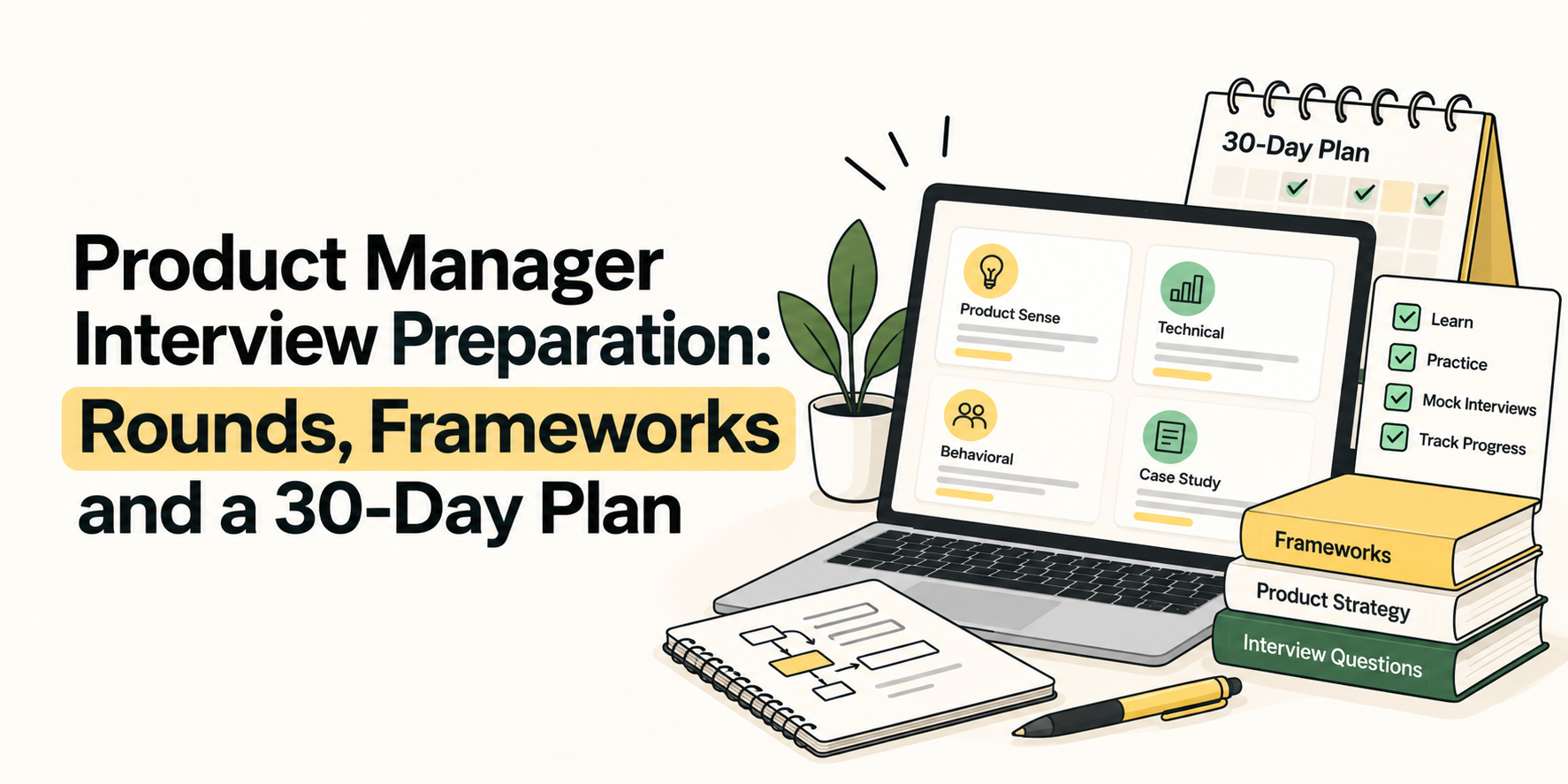
You’ve got the call. The recruiter says there will be “four or five rounds,” and then the line goes quiet. Four or five rounds of what?
Most people prepare for a PM interview as if it were one exam. They memorise a list of questions and hope the right ones come up. But a PM interview is a series of different tests, and each round checks something different. The round that asks you to design a product isn’t testing what the metrics round tests. If you use the same approach for both, you’ll feel prepared and still get stuck.
This product manager interview preparation guide is built around the rounds themselves. For each one, you’ll see what it tests, the framework that fits, and the TPF case studies that train it. You’ll also get a guide to the take-home assignment (the part many guides skip), a 30-day schedule, and a short checklist for the final 48 hours.
Formats vary from company to company, but most hiring processes for product manager roles in India follow a similar order. Expect four to six steps, sometimes on a single day and sometimes spread over a few weeks. If you want to prepare for product manager interview rounds properly, start by knowing the sequence.
A referral can get your resume in front of a person faster, but the rounds themselves are the same either way. This table shows the usual order. Treat the timings as typical, not guaranteed.
| Round | Format | What is tested | How to prepare | TPF resource |
|---|---|---|---|---|
| 1. Recruiter screen and resume | 20 to 30 minute call | A clear story, why PM, practical fit | A 60-second story and a resume with numbers | product manager interview questions with answers |
| 2. Product sense and product design | 45 to 60 minute live discussion | Understanding users, choosing problems, trade-offs | The CIRCLES method on design prompts | product design case studies |
| 3. Case study, guesstimate and RCA | 30 to 60 minute live problem | Structure, estimation logic, narrowing down causes | A framework for each case type | product manager case study interview guide |
| 4. Metrics and analytics | 30 to 45 minute live discussion | Picking the right metric, guardrails, experiments | The GAME framework | metrics case studies |
| 5. Behavioural and leadership | 45 to 60 minutes with a hiring manager or leader | Ownership, teamwork, handling conflict, results | A bank of STAR stories | Mock interviews section below |
| Take-home assignment (sometimes) | Hours to days, then a discussion | Depth, judgement and clear writing | See the take-home section | Take-home section below |
The first call is usually with a recruiter or an HR partner, and it’s shorter than people expect. It’s a filter. In many a pm interview process, this call decides whether a hiring manager ever sees you.
What it tests: Three things: can you explain who you are clearly, do you understand what a PM does, and do the practical details fit? Recruiters in India commonly ask about your notice period and your current and expected pay in this call, so have honest answers ready.
How to prepare:
Practise: The “tell me about yourself” and motivation questions in our product manager interview questions with answers are a good place to start. Answer each one aloud, and time yourself. If you go past two minutes, cut.
This is the round most people picture when they hear “PM interview.” You get a prompt such as “Design a way for office teams to order lunch together,” and around 45 minutes to think out loud. In a product manager interview, “product sense” means your instinct for what users need and which problems are worth solving. It’s learned by practice, not talent.
What it test: Whether you understand a user before you propose anything, whether you can choose one problem out of many, and whether you can explain the trade-offs of your idea.
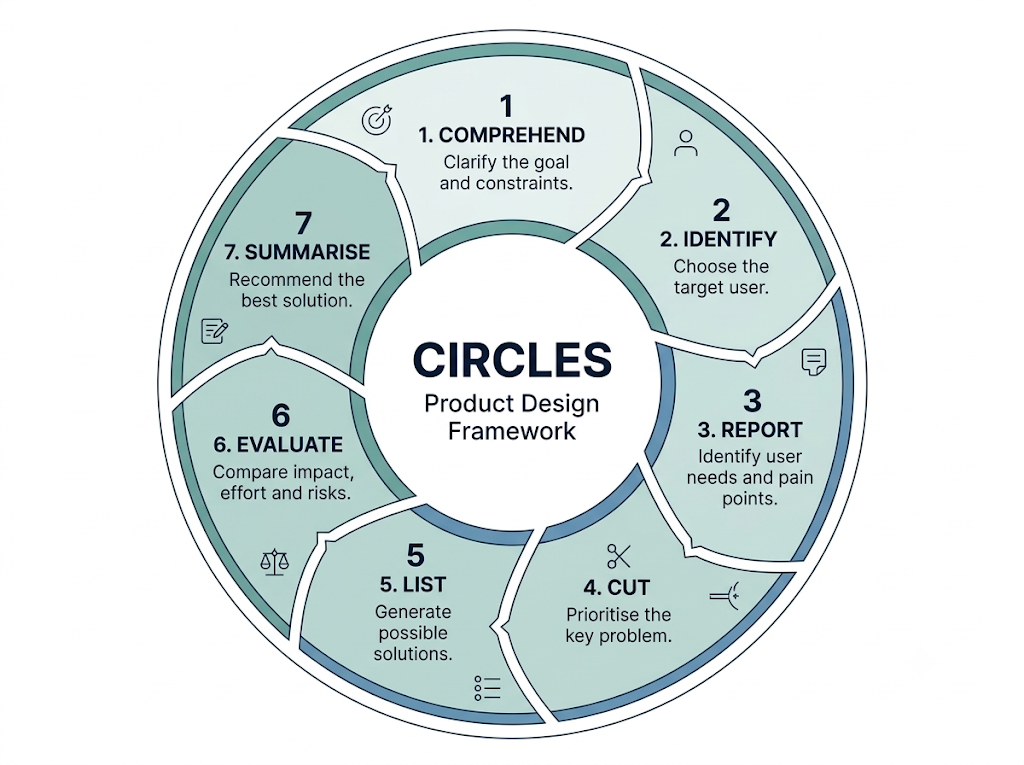
The standard tool is Lewis C. Lin’s CIRCLES method. Each letter is a step:
The first three steps are where you earn the last four. Spend roughly the first third of your time on the user before you suggest a single feature. For Indian consumer products, be specific about who the user is: a first-time smartphone owner and a shop owner on a shared phone need very different things. “Everyone” isn’t a user.
Pick one prompt from our product design case studies and set a 30-minute timer. Speak your answer aloud instead of writing it. When you finish, check three things: Did I choose one user? Did I name one real problem before solving it? Did I end with a recommendation? Do this for six different prompts across a week, and compare each answer with the solved version.
Round three is a family of problems, not one. You might estimate a number (a guesstimate), work out why a number dropped (root cause analysis, or RCA), or improve an existing product. Product management interview preparation often goes wrong here because people use one approach for all three. Name the type in the first ten seconds, and you’ll know which tool to reach for. Our product manager case study interview guide covers all five question types in depth.
What it tests: Structure, comfort with numbers, and judgement. The interviewer wants to see you break a messy question into parts, state your assumptions and reach a conclusion.
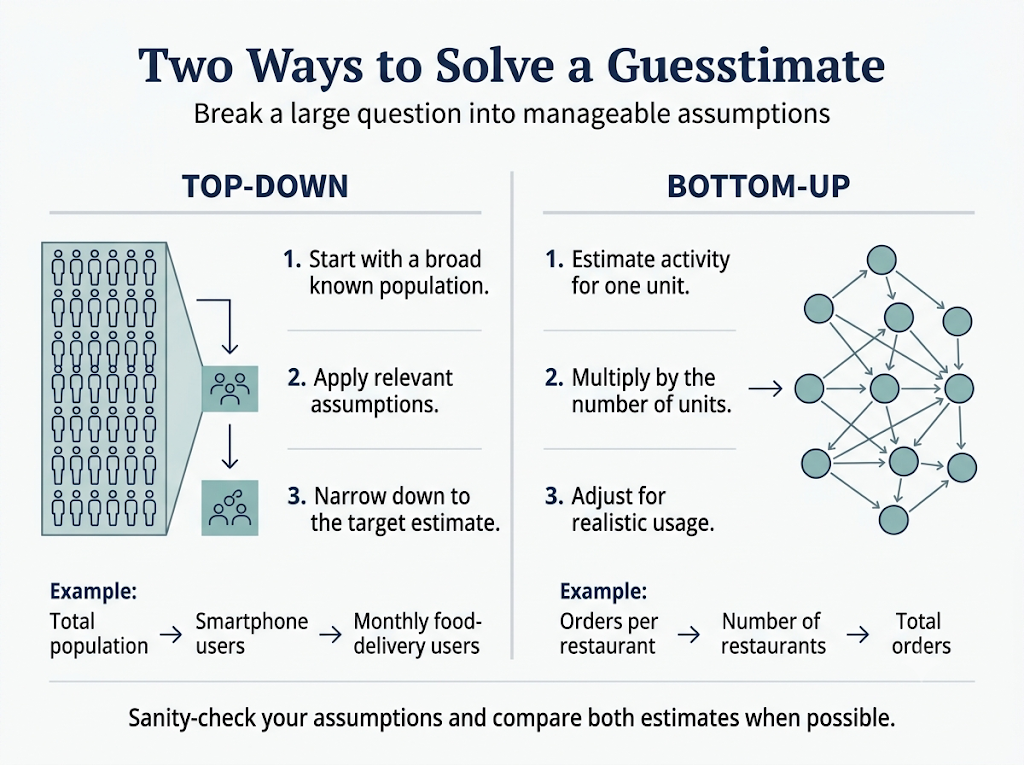
Guesstimates: top-down or bottom-up. Top-down starts with a large number you roughly know and narrows it. Bottom-up starts with one unit, like a single café, and multiplies up. Say your route out loud, state each assumption, and if time allows, cross-check with the other route. When both land in the same range, you can say so with confidence.
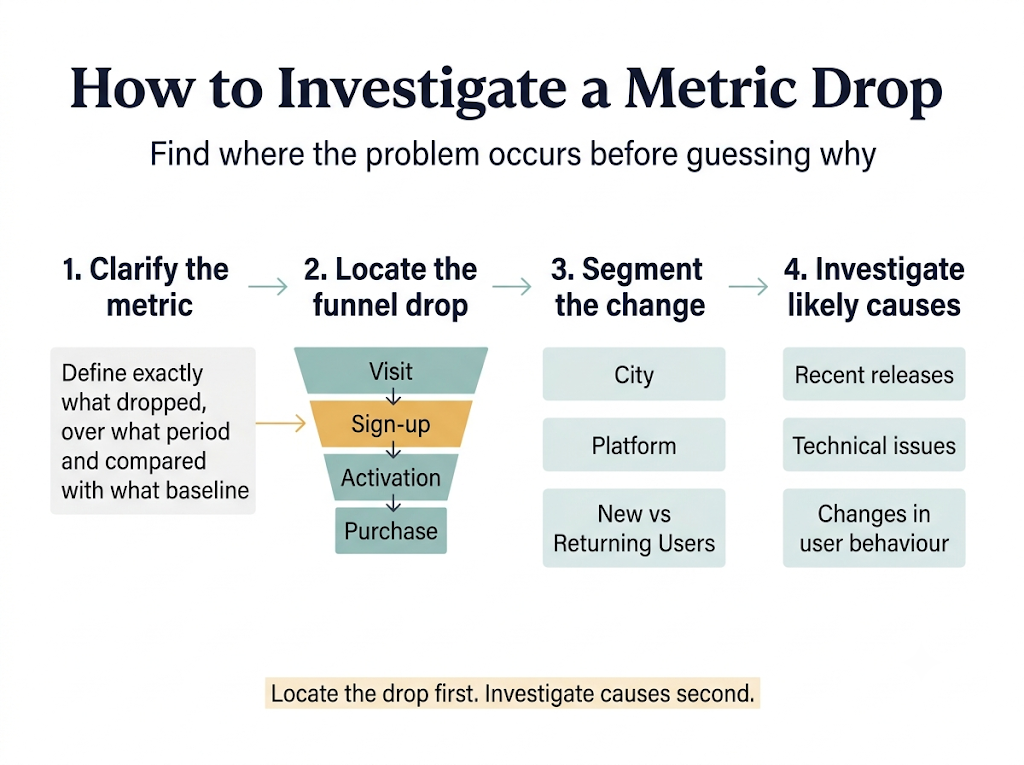
RCA: funnel first. Clarify the metric (placed or delivered? compared with when? sudden or gradual?). Then find the stage of the user journey where it dropped, cut the drop by segment (city, platform, new or returning users), and only then rank possible causes. A sudden drop on one day usually points to something that broke, so check recent releases first.
Improvement: pick one thing. Choose which part of the product to improve and for whom, say why, then use CIRCLES from the “Comprehend” step. The strongest answers resist listing twenty ideas and defend one.
Work in sets of three, one of each type, so you keep switching frameworks:
After each one, Ask: Did I state my assumptions? Did I check my answer with a second method or a sanity test? Did I finish with a clear conclusion rather than a list?
Good pm interview prep for this round starts with one question: how will we know it worked? You might be asked “How would you measure the success of a new one-tap reorder feature?” or “Which metric would you track for a video app’s recommendations?”
What it tests. Whether your metric matches the goal, whether you can balance a main metric with supporting ones, and whether you know how to check that a change really caused the result. You don’t need to be a data scientist. You need to be clear and careful.

There’s no industry-standard framework for metrics questions, so we teach a simple four-step chain that spells GAME. It’s our own tool; in the interview, present it as “here’s how I’d structure this.”
A guardrail is a second metric you watch to make sure you aren’t winning one number by hurting something else. For example, if you raise watch time by serving addictive content, trust may fall. When you mention experiments, keep it simple: run an A/B test (one group of users sees the change, another group doesn’t), and check that the result holds after a week or a month, not just on day one.
Take five prompts from our metrics case studies and write the four GAME sentences for each before you read the solved version. If you can fill in all four sentences quickly and with confidence, you have a metrics answer.
Behavioural answers are the easiest part of product manager interview prep to reuse, because the same stories answer many questions. The interviewer is usually the hiring manager or a senior leader, and the questions sound like “Tell me about a time you disagreed with your team” or “Describe a launch that didn’t go as planned.”
What it tests: Ownership, teamwork, how you handle conflict and failure, and the results you’ve delivered. For senior roles, it also tests how you lead people and influence without authority.
STAR gives each story four parts:

Weak answers often spend too long on the situation and too little on the action. Aim for roughly a quarter of your time on the context and half on what you personally did.
Build a bank of six stories that can flex across questions: a disagreement, a failure, a time you influenced without authority, a tight deadline, a decision made with data, and a customer insight that changed your plan. Write each in five bullet points, and practise telling each in under two minutes.
A short example: “Our onboarding completion rate was stuck (situation). I owned fixing it (task). I looked at where users dropped, found that nine steps were too many, and worked with design and engineering to cut it to four (action). Completion rose from 38% to 61% in two months, and I learned to test fewer steps before building a new flow (result).” Use your own real story and numbers instead of this one.
The product manager take home assignment is the part of the process that most candidates underestimate. Some companies give you a prompt, a few hours to a few days, and ask you to submit a document or short deck. You then present and defend it in a follow-up conversation. Because you have time, interviewers expect more depth than in a live round, and a thin answer stands out more than a thin live answer.
A structure that works:
How it is scored. There’s no universal rubric, but most reviewers look at the same things: clear structure, insight about the user, judgement in the choice you made (and what you left out), realistic metrics, and writing that’s easy to skim. They also look at how well you defend it. Expect questions such as “What would you do if engineering said this takes six months?”
Common mistakes: padding the document to look thorough, jumping to a solution before defining the problem, hiding the recommendation on the last page, ignoring constraints you were given, and over-designing slides instead of sharpening thinking.
A strong take-home can also become a portfolio piece. If you’re proud of it and the company allows it, adapt it for your product manager portfolio.
This is a four-week product manager interview preparation plan for someone who can give one to two hours on weekdays and a longer block at the weekend. A good pm interview preparation plan isn’t about covering everything. It’s about repeating the same few skills with feedback until they feel natural. If you have less time, stretch it to six weeks instead of skipping practice.
| Week | Focus | What to do | What you should have by the end |
|---|---|---|---|
| Week 1 | Foundations and your story | Learn the rounds. Write your 60-second story and rework your resume with numbers. Read the Cracking the PM Interview summary for a quick overview of the book. | A final resume, a 60-second story and three projects you can explain |
| Week 2 | Product sense | Learn CIRCLES. Do six product design prompts aloud. Write one product teardown of an app you use, using our product teardowns as a guide. | Six practised answers and one finished teardown |
| Week 3 | Cases and metrics | Do a set of three cases each (guesstimate, RCA, improvement) and five metrics prompts with GAME. | Notes on which case type is your weakest |
| Week 4 | Mocks and take-home | Do three full mock interviews. Practise one take-home from start to finish. Build your STAR story bank. | Feedback from three mocks and a bank of six stories |
Two habits matter more than the schedule. First, practise out loud, because writing an answer and saying one use different skills. Second, review each session: write down one thing that went well and one thing to fix, then fix it in the next session.
Mocks are where preparation turns into performance. You can read every framework and still lose your structure when someone is watching.
Where to find mocks:
How to use feedback:
Don’t learn new frameworks now. In the last two days, you’re sharpening, not studying.
Two days before:
The day before:
On the day:
The rounds are similar for everyone, but the weight changes with your level.
APM and fresher interviews
For product manager interview preparation for freshers, the focus is on potential. Interviewers know you haven’t done the job, so they look for product sense, clear thinking and signs that you’ve practised. Your “experience” comes from internships, projects, teardowns and case practice, so build that proof. Spend most of your time on product design, guesstimates and metrics, and use college or internship projects for your STAR stories.
Experienced PM interviews
Here the questions go deeper into what you’ve actually owned. Expect follow-ups such as “What was your role in that decision?” and “What would you do differently?” Prepare detailed stories with outcomes and trade-offs, and be ready to discuss how you worked with engineering, design and leadership. For senior roles, add strategy, roadmap decisions and how you lead other people.
Career switchers
If you’re moving into product from engineering, design, marketing or operations, translate your work into product terms: which problems did you spot, which decisions did you influence, and which results can you show? Then fill the gaps with case practice.
Here’s how to prepare for product manager interview rounds: learn what each round tests, pick one framework per round (CIRCLES for design, top-down and bottom-up for guesstimates, funnel-first for RCA, GAME for metrics, STAR for behavioural), practise out loud with real case studies, and do mock interviews with feedback. Add a take-home practice run and a final-48-hours checklist. The 30-day plan above puts these steps in order.
Our plan takes 30 days, assuming one to two hours on weekdays and a longer block at the weekend. If you’re switching into product, have little time each day or haven’t practised cases before, allow six weeks. What matters most is steady practice with feedback, not the number of days. A good pm interview preparation plan keeps repeating the same skills until they’re automatic.
The product manager interview frameworks worth learning are: CIRCLES for product design and improvement, top-down and bottom-up for guesstimates, the funnel-first method for RCA, GAME for metrics and STAR for behavioural questions. Treat each as a scaffold, not a script. They give you a place to put your thoughts so you can focus on the problem.
Many product manager interview rounds follow this order: a recruiter screen, product sense or design, a case round (guesstimate, RCA or improvement), a metrics round and a behavioural round with a hiring manager or leader. That’s typically four to six steps, and some companies add a take-home assignment. Formats vary, so ask the recruiter for the exact sequence when you get the call.


Into the Future