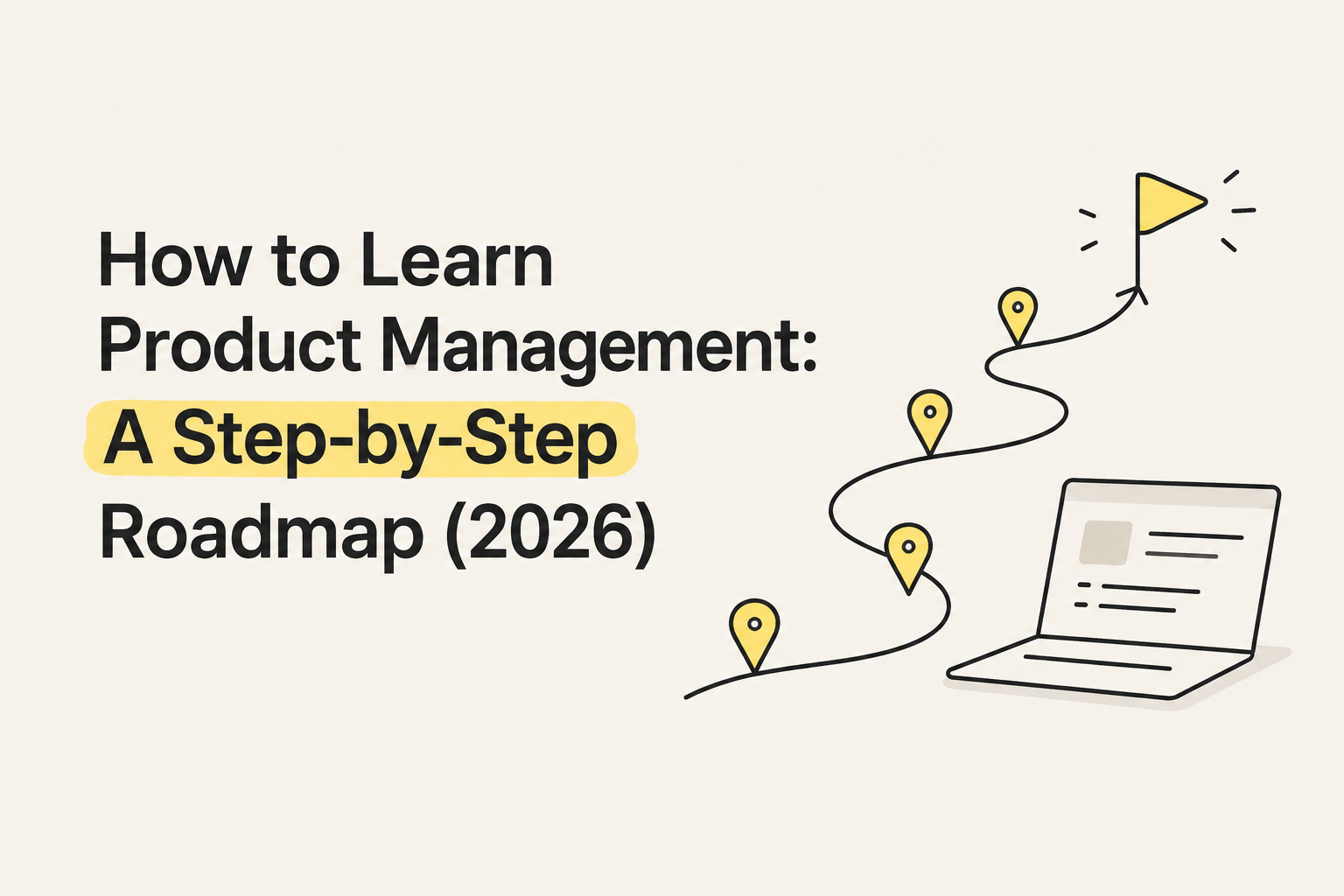
If you've searched how to learn product management, you've probably already hit the two answers everyone gives: sign up for a paid course, or read a 40-item list of books, newsletters, and YouTube channels with no order to any of it. Neither tells you what to actually do on Monday morning.
This is the third option, a step-by-step self-learning path, in the order that actually builds judgment, using free resources first and paid ones only where they genuinely add something a beginner can't get for free. Follow it in order and you'll go from "I've read about product management" to "I can reason like a PM under pressure" in about 90 days.
Start with a caution, because it's the single biggest reason self-learners plateau: the instinct is to learn Jira, agile ceremonies, roadmap templates, and estimation techniques first, because that's what makes you sound like a PM in a room. But none of that is where product management actually starts. Those tools were built later, to solve operational problems inside teams that already knew what they were building and why.
The real foundation is four questions, asked about any product in front of you:
Beginners who spend their first month on process usually sound fluent in a mock interview, right up until someone asks why users are dropping off, and the answer goes quiet. Beginners who spend that same month reading complaints, watching real usage, and sitting with the friction build something the first group doesn't: an instinct for why products win or fail. The frameworks PMs reach for, the ones we'll walk through step by step in this roadmap, are just tools for organizing that instinct once you have it. They're not a substitute for building it.
Product management isn't one skill, it's six, and trying to learn all six at once is exactly why most self-learners stall out after a few weeks. Stack them in this order instead. Each one gives you the vocabulary the next one needs.
Skills 1 to 3 are judgment skills, slow to build, and exactly what interviewers screen for. Skills 4 to 6 are craft skills that improve fast once you're doing real work or realistic practice. None of the six exercises above need a course. They need repetition.
When you're starting out, it's easy to mistake learning more things for making more progress. You don't need to master the entire PM toolkit on day one.
1. Memorising every framework. You don't need to memorise RICE, ICE, Kano, JTBD, MoSCoW, HEART, and dozens of other frameworks. Learn a few, understand why they exist and when to use them, then focus on solving actual product problems.
2. Learning everything at once. SQL, Power BI, Figma, Jira, analytics, AI, coding: you don't need all of them immediately. Start with product fundamentals and add skills as your work requires them. Depth beats a long list of half-learned tools.
3. Choosing your PM path too early. It's okay if you don't know whether you want to become a growth, technical, AI, platform, or consumer PM. Build the core skills first; your interests and strengths will help determine your direction later.
4. Spending months learning one tool. Don't spend weeks watching Jira or Figma tutorials just to say you're "proficient." Learn enough to complete the task in front of you, then move on. The tool is never the skill; the product decision is.
As a beginner, your priority should be simple: understand users, identify problems, practise solving them, and learn from your mistakes.
Don't start with a book. Books assume you already have a mental model to hang new information on, and without one, a chapter on prioritization won't stick by the time you're two chapters further in. Start with something structured that builds that scaffolding first.
The Product Management Fundamentals course is built for exactly this stage. Worth knowing upfront: this is a paid course, $149, confirmed directly from the course's own FAQ, not a free one, despite how it's sometimes described elsewhere online. It's a 10-week, cohort-based program taught by practitioners from Freshworks, Razorpay, Swiggy, and Mixpanel, ending in a real final PRD. Each module gives you the words and ideas you'll need for the next one, so nothing feels dropped in without context.
If a free entry point matters more to you than the full 10-week program, TPF also runs GenAI Rush, a genuinely free cohort on generative AI product work, and the live sessions of Product Analytics 101 are free to attend as well, covered further in Step 5.
Before you start learning tools, frameworks, or interview tricks, get these five ideas clear. They are the foundation of good product thinking.
Reading ten PM books back-to-back at the start is one of the most common ways beginners waste three months. You retain almost none of it, because there's no practice loop to test the ideas against. Read three, apply them, then come back for more. For a longer list once you're past month one, TPF's best product management books roundup is worth bookmarking.
This is the step most people skip, and it's the one that actually builds judgment. Reading about prioritization frameworks won't teach you to prioritize under ambiguity. Solving real case studies will.
The order that works: guesstimates to RCAs to product design to metrics
Work through TPF's product management case studies library in this sequence:
Aim for 3 to 5 case studies a week. Five done thoughtfully, every week for ten weeks, will build more judgment than fifty rushed through in a single weekend.
Product teardowns are where you build taste, not just structure. Case studies teach you to reason. Teardowns teach you to notice.
Pick an app you already open every day. Then take one feature and pull it apart:
Do this once a week, and something shifts after a few weeks. You stop reaching for "I'd use RICE" every time someone asks how you'd approach a feature, and you start having an actual opinion, one you can back up when someone pushes on it.
TPF's Product Analytics 101 module is where this skill actually clicks, because it works through real dashboards instead of slides, and its live sessions are free to attend. Learn the difference between leading and lagging indicators, learn to read a funnel until you can spot the exact step where people give up, and get in the habit of questioning a number before you present it: what's the sample size, is this seasonal, did someone quietly change how the metric is even defined.
AI is becoming part of everyday product work, but knowing how to use an AI tool is different from knowing how to build a useful AI feature. As a PM, you need to understand what the feature should do, where AI adds value, and how you'll know whether it works well enough for users.
Start with three questions:
What should the AI solve?
How will you evaluate its output?
What does success look like?
Practise this by picking an AI product you already use and evaluating one feature. Write down what it does well, where it fails, what risks those failures create, and what you'd measure before rolling it out to more users.
Explore AI for Product Builders for further learning.
Don't wait until you "know enough" to start a portfolio. Build it from the work you're already doing in Steps 3 to 5. Three deeply-reasoned case studies and two sharp teardowns beat ten shallow ones. For each piece, don't just show the final answer, show the two or three points where you changed your mind mid-analysis. For the full build process, see how to make a product manager portfolio.
By this point you're not starting from zero, you've done the reps. What's left is speed and delivery: practicing out loud with a timer, tightening your case study structure to fit a 30-minute slot, and rehearsing your stories so they lead with the decision, not the backstory. For question-by-question prep, TPF's PM interview questions with answers guide is the natural next stop.
There's no single right way to learn product management, only the path that matches your timeline, your budget, and how much structure you personally need to follow through.
If you're the kind of person who follows through without a deadline forcing your hand, self-learning gets you there for the price of a few books. If you know you need structure and real practitioner access to actually finish something, Product Academy fills that gap for $149. The Fellowship is the right fit if what you're actually after is community and mentorship over a longer stretch, it's not positioned as a placement guarantee, so weigh it on the community and learning it offers rather than a promised job outcome.
This is a realistic product management roadmap for beginners, not an aggressive one; falling a week behind on any stage is fine as long as you don't skip the sequencing in Step 3.
If you want the complete list of no-cost material to pair with this roadmap, including genuinely free certifications and courses, TPF's free product management courses roundup is the fuller toolkit covering every step of this plan.
Yes. You can learn many product management fundamentals for free through articles, case studies, product teardowns, community discussions, and other learning resources. You can also practise with products you already use. Check course pricing before enrolling, and remember that consistent practice and feedback matter more than collecting certificates.
Most consistent self-learners can work towards interview readiness in three to four months by following a structured plan. Your timeline depends on how much time you can commit, how regularly you practise, and whether you get feedback on your work. Add a month or two if you're learning alongside a full-time job or degree.
No. A certification isn't a requirement for becoming a product manager. Hiring managers want to see how you understand users, frame problems, prioritise solutions, reason through trade-offs, and communicate decisions. Practical case studies, a thoughtful portfolio, and relevant experience can help demonstrate these skills.
It's a different learning curve, not necessarily a harder one. Problem framing, user understanding, and prioritisation don't require a computer science degree. Learning technical concepts and product analytics will help you work more effectively with engineers and make better-informed product decisions as you progress.
Follow a structured learning path, practise case studies regularly, analyse products used in India, and get feedback from other PMs. Examples involving UPI, quick commerce, fintech, and vernacular content can help you prepare for interviews involving Indian users and markets. Online product communities are also useful for feedback and networking.
Follow the seven steps above in order, starting with the four foundational questions before any tool or framework. This makes it a product management self study plan rather than just a reading list: each step builds the vocabulary the next one needs. Start small, practise regularly, and revisit your mistakes instead of constantly switching resources.
Steps 3 through 6 are designed to help you demonstrate product thinking before you have a formal PM title. Case studies and teardowns let you show how you frame problems, compare solutions, and make trade-offs. A portfolio built from this work can support your applications, although hiring outcomes also depend on the role and employer.


Into the Future