Mastering the Art of AI Collaboration in building EdTech products🥳
As Product Managers, when we build products, we're not just consumers of AI; we're designing a new working relationship with it. This transition demands leadership that moves beyond the hype and focuses on strategic partnership—a concept best understood as Co-Intelligence.
Think of AI as an incredibly bright, tireless, but somewhat unpredictable junior co-pilot. The critical decision for us isn't if we use AI, but where to draw the line between human intuition and machine capability. This is the PM's new strategic challenge. We must map our AI deployments against the "Jagged Frontier" of its capabilities: where it excels (tireless scale) and where it fails (contextual nuance) (read: Co-intelligence)
🤔 The PM's Core Question: To Augment or To Automate?
Before we deploy any model, we must fundamentally redefine our workflows. The question isn't "Can AI do this?" but "Does using AI here unlock significantly more human creativity or student value than the risk it introduces?"
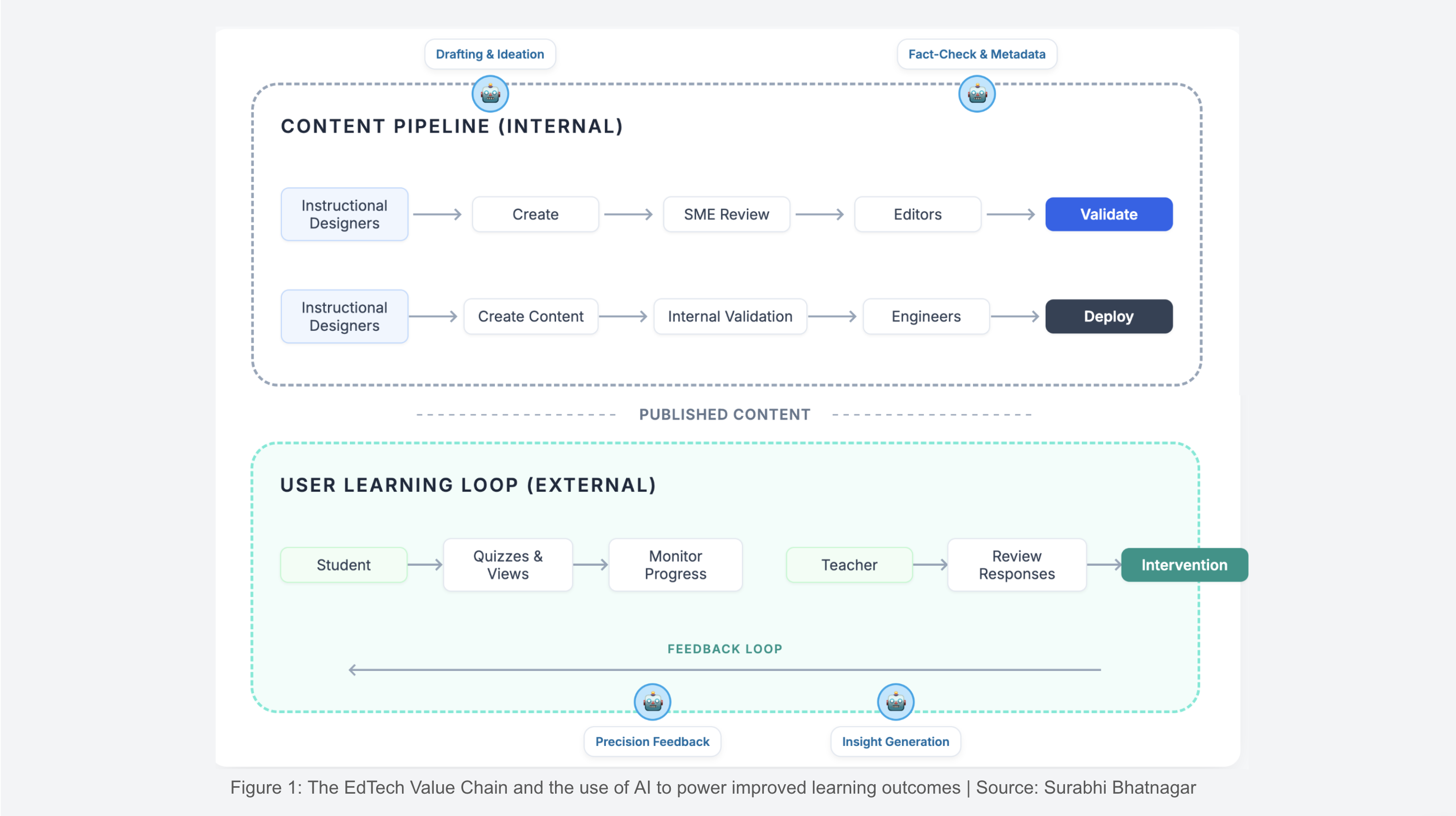
To answer this, let's first establish a foundational understanding of the EdTech learning process. The learning loop moves from content creation to student action to teacher intervention:
The User Learning Loop (External): Student attempts Quizzes/Views Explanations -> System logs responses -> Teachers monitor progress and deliver interventions.
The big AI question
In this essential learning loop—from content creation to student feedback to teacher intervention—where are the moments of high-volume, low-nuance drudgery that AI should take on, and where are the moments of high-stakes, high-empathy judgment that must remain strictly human?
Places AI Can Supercharge Your EdTech Product
To frame the answer, we look at where AI can augment workflows across three dimensions: internal velocity, direct customer value, and operational efficiency.
Dimension
Use Case
Primary Goal
I. Internal Velocity
Content Generation: Generating initial quiz structures, first draft explanations, or lesson summaries.
Shift Instructional Designers from drafting to editing.
Feedback Synthesis: Categorizing and clustering thousands of pieces of freeform customer feedback.
Shift PMs from data analysis to strategic problem solving.
Code Review and Testing: Proactively flagging repetitive flaws and generating test cases.
Accelerate Engineering Development and automate basic quality checks in merge requests.
II. Core Customer Value
Accelerate assessment: Automated grading of complex, open ended text based on conceptual mastery without waiting on customer support teams.
Deliver immediate and accurate feedback.
24/7 Learning Companion: AI tutor learning from your site’s content and handling first tier queries and common misconceptions.
Provide instant support and reserve human tutors for high empathy needs.
III. Operational Efficiency
Personalized Learning Paths: Dynamically adjusting content difficulty based on real time performance.
Improve student engagement and learning outcomes.
Automated Captioning: Converting video and audio content into high quality captions.
Reduce operational costs.
🛑AI No go zone: When to AVOID deferring to AI (Anti-Examples)
As PMs, we must evaluate potential AI deployments based on two key factors: Conceptual Risk (The potential for factual error, bias, or harm) and Value Impact. It’s a go if Value far exceeds risks. These examples show high risk far outweighing the benefit in an EdTech context.
Anti Example (The Temptation)
Prohibitive Limiter (The Risk)
PM Takeaway (The Decision)
Allowing the AI Tutor to provide direct answers or cheats.
Undermining Pedagogy. The AI’s job is to support learning, not help students bypass effort or cheat the system.
Fine tune the AI for scaffolding and hint logic only. Protect the core learning process.
Sharing detailed student performance data with a third party LLM for tutoring.
Privacy and Ethical Risk and Data Security. Even non PII performance data creates a security boundary we are unwilling to cross right now.
Prioritize student safety. Evaluate the non augmented AI’s performance first and wait for secure, on premise solutions.
Using an LLM to generate detailed class performance insights for teachers.
Privacy and Ethical Risk and Operational Overhead. Analyzing class performance requires sharing sensitive student data, and the data cleaning cost is often too high.
Prioritize data integrity and privacy. Keep high stakes teacher facing data strictly within secure, first party systems.
Full, Unsupervised Grading of Final Exams.
High Stakes Risk. If the consequence of an error is life altering, for example course failure, the human must remain the final authority.
Limit AI to assistance and require human final sign off for all summative assessments.
🗺️ Your Actionable AI Framework: The Co-Intelligence Quadrants
To make the 'when to use it' decision simple, we map our choices using these quadrants: As Product Managers, our leadership is defined by how well we move beyond chasing AI features and instead become the architects of the AI Value Chain. Start with the Quick Wins to build momentum, and then fund your high-impact Core Experience Transformers.
About the Author:
Surabhi Bhatnagar is a London-based Product Leader driving B2B growth at a UK based EdTech scale up. Previously she led product teams at Microsoft & Google to build products in productivity, AI/ML and cybersecurity for millions of users.
blogs
Break into
Product Management
Benefit from our wide pool of initiatives to give you a starting point to begin your product management journey
July 22, 2026
From Roadmaps to Real-Time Systems: Rethinking Product Management for the AI Agent Era
For most of my career, product management was built around a familiar rhythm. We defined strategy, translated it into roadmaps, aligned stakeholders, prioritized features, and executed against milestones.
Before you find your niche, it helps to understand the different ways PMs can specialize. There are two broad dimensions to consider: vertical and horizontal specializations.
As Product Managers, when we build products, we're not just consumers of AI; we're designing a new working relationship with it. This transition demands leadership that moves beyond the hype and focuses on strategic partnership—a concept best understood as Co-Intelligence.

.png)


.avif)

.avif)
.avif)
.svg)

.svg)
