A resume tells a recruiter what you claim you can do. A product portfolio shows them. That's why the strongest PM candidates now walk into interviews with a link, not just a PDF: it lets a hiring manager see how you think, not just how you describe thinking.
This guide covers what a portfolio is and isn't, who needs one, ten portfolio examples worth building, what to put inside, a weekend build plan, a free template, and how to start with no experience.
A resume states outcomes. A portfolio explains how you got there.
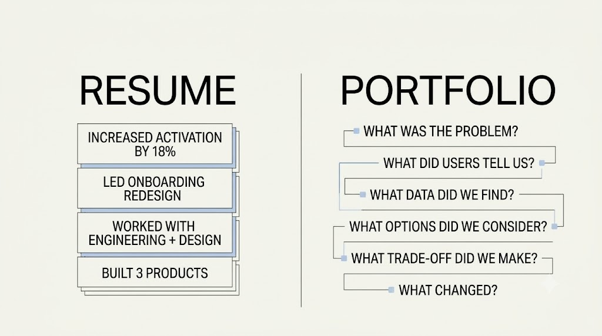
A resume bullet is a claim. A portfolio entry is the argument behind it. "Increased activation by 18%" says nothing about why activation moved or what you decided. Walk through the chain instead: what was broken, what users told you, what the data showed, which options you ruled out, what trade-off you made, and only then what changed. The same fact becomes evidence of how you think.
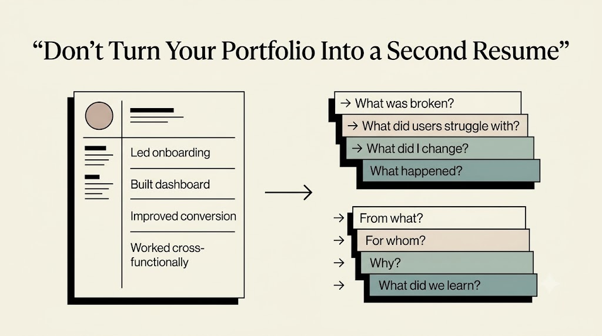
The most common way portfolios fail is by quietly turning back into a second resume.
If an entry could be read aloud in the same flat tone as a resume bullet, it's still a resume bullet. Run each line through those chains before you publish it. "Led onboarding redesign" becomes "onboarding was broken because X, users struggled with Y, I changed Z, and here's what happened." A product portfolio example done well reads like a short case study, not a highlight reel.
Not every PM needs one, and treating it as mandatory for everyone wastes effort.
| Level | Need one? | Why |
|---|---|---|
| Fresher: breaking in with no PM title | Essential | Without a job title, a portfolio is often the only evidence you can do the work. |
| APM, first PM role or career switcher | Strongly recommended | It's the fastest way to close the gap between "I want to be a PM" and "here's proof I already think like one." |
| Experienced: mid-level PM (2 to 5 years) | Useful | Helps when changing industries or company size, less critical if your resume already carries verifiable outcomes. |
| Experienced: senior or Group PM | Optional | References and a track record recruiters can verify matter more. |
| AI PM or a niche specialisation | Recommended at any level | The space is new enough that visible hands-on work carries unusual weight. |
You don't need all ten. These are ten different ways to demonstrate product thinking, so pick the three or four that fit what you actually have. Real portfolios are linked where they illustrate a point. Study what each PM chose to make visible, not the design.
The foundation of most portfolios. Say users sign up for a food delivery app but don't place a first order. You trace the funnel (sign-up → browse → restaurant view → add to cart → checkout → payment) and find the biggest unexpected drop between restaurant view and cart. Instead of proposing a "better restaurant page," you dig into interviews, session recordings, reviews, restaurant availability, delivery fees and search behaviour. You find that fees aren't visible until late in the journey. Now your recommendation has a reason, which beats "I redesigned the restaurant page to improve UX."
Use real results if you have them. Don't manufacture them if you don't. To practise this format, work through TPF's product management case studies.
The easiest way to show product sense with no professional experience. Pick something you actually use (Blinkit, Spotify, Google Maps, Swiggy, Duolingo, Notion, ChatGPT, Zepto, Instagram) and one problem inside it, not the whole product: "Why does Duolingo push daily streaks so aggressively?"
Ask what behaviour it's shaping, which metric it probably moves, why it works, where it could backfire, and what else could drive the same retention. Land on one recommendation. A teardown isn't a 40-slide redesign. TPF's product teardowns challenge is a structured place to try it, and the teardown winners it spotlights show what analysis beyond "this button should be blue" looks like.
Document the thinking, not just the output. "I built an AI resume builder using Gemini" is implementation. The product story is: "Job seekers kept rewriting the same resume for every job description, so I explored how an AI workflow could turn one generic resume into a job-specific version."
Then show what you observed, who you built it for, what you assumed, what you built first, what didn't work, what users said, what you changed and what's next. This is especially valuable early in your career, because you own the whole journey. David Jones's portfolio pairs real product leadership experience with visible proof of building.
You don't need a dashboard with twelve charts. You need a question: where are users dropping out of this onboarding funnel? Say 100,000 land, 40,000 sign up, 25,000 complete a profile and 8,000 reach the core action.
"The conversion rate is 8%" is the boring version. The interesting version asks why the biggest drop sits between profile completion and the core action. Then build hypotheses: users don't know what to do next, the value isn't obvious, the core action has too much friction, or onboarding promised something different. That's analytics turning into product thinking.
"I used ChatGPT" stopped being an interesting story a while ago. A strong AI case study asks harder questions. Should a support product let an AI agent auto-resolve tickets? Which tickets are safe to automate? What happens when the model is wrong? When does a human step in? How do you judge response quality and catch hallucinations?
Structure it as problem → AI opportunity → where AI helps → where it shouldn't → evaluation → human fallback → metrics. Elena Calvillo's portfolio includes an AI experience you can actually interact with. Don't just say you understand AI. Give people something to use.
Skip the 25 pages of "leveraging synergies to create a seamless omnichannel ecosystem." Include the problem, goal, non-goals, user stories, requirements, edge cases, success metrics and open questions. The last one is underrated: showing what you don't know yet is often more convincing than pretending you know everything.
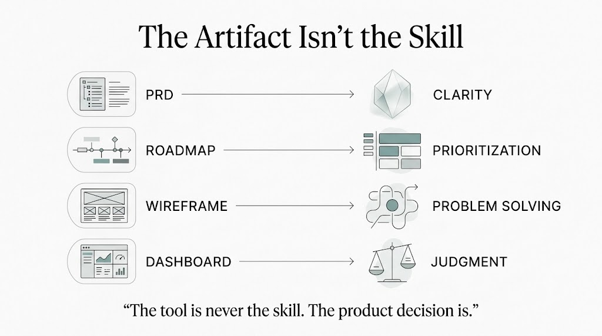
Nobody is checking whether you can format a requirements doc. A PRD proves clarity, a roadmap proves prioritisation, and a dashboard (example 4) proves judgment. Write toward the skill, not the document.
Say a productivity app has plenty of sign-ups but poor retention. Don't jump to "send more push notifications." Start with acquisition → activation → engagement → retention → monetisation, then ask where the biggest drop is, which users retain, and what behaviour correlates with staying.
If users who create a first project within 24 hours come back far more often, your problem is no longer "improve retention." It's "how might we get more new users to create a first project within 24 hours?" That reframe is what makes a growth case study land.
Everyone shows "we launched, users loved it, metrics went up." Real product work rarely looks that clean. If something didn't work, write it up: what you believed and why, what you built, what happened, what you got wrong, what evidence you missed, and what you'd do differently.
That isn't a weakness. It's proof you can learn, as long as you can discuss it honestly in an interview. Matthew Stublefield's case studies make lessons and failed approaches visible instead of burying them.
This shows you think beyond individual features. "How should a quick-commerce company expand into a new category?" Look at the market, users, competition, business model, differentiation, constraints and risks, then make a call. The number of frameworks you use doesn't matter. What matters is whether your recommendation follows from the evidence.
Your portfolio doesn't have to look like everyone else's. A developer moving into product can show technical-product work. Someone from analytics can show data-driven decisions, from marketing growth and customer understanding, from design how research shaped a call. Your background isn't something to hide so you can look like a "real PM." It's part of the story.
You also don't need a custom website. Vipul Singh's and Archit Kaushal's Notion portfolios show that a clean Notion page is enough, and Yashika Goel's Framer site shows the other route: a designed, standalone website.
There's no single correct format. The strong ones make at least one of these visible: a measurable outcome, a hard decision, a clear point of view, evidence of building, something that didn't work, or a distinctive area of expertise. Whether it's a Notion page or a custom site, the pattern is the same: the work is easy to find, easy to skim, and explains the thinking behind it. Don't copy anyone's layout. Copy the thinking behind it.
Pick two or three case studies that show different skills, such as product design, guesstimates, and root cause analysis (RCA). Practise with TPF's product management case studies.
Choose one or two products you actually use. Identify a specific problem and suggest a practical solution. See TPF's product teardowns for how others do it.
Include products you've built or feature ideas you've documented. Explain the problem, your decisions, and what you'd improve next. Clearly label concepts that haven't been built.
Show how you'd measure success using real results where available. For proposed features, explain which metrics you'd track and why.
Keep it short and personal. Explain what interests you about product management, the problems you enjoy solving, and the opportunities you're looking for. Include your contact details or LinkedIn profile.
Three well-chosen pieces that show range beat ten thin ones. If you don't have professional work to showcase yet, a case study or product teardown can fill the gap honestly.
For each project, explain the situation, what you did, what happened, and what you'd do differently now. That last part signals a maturity a clean success story can't.
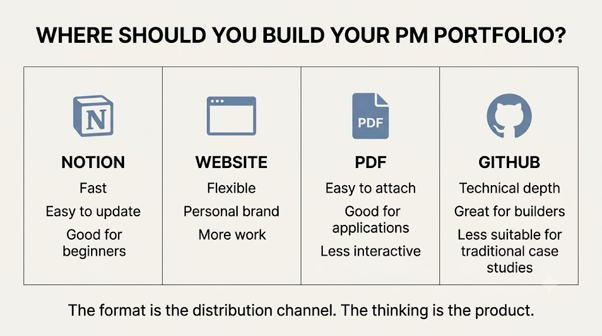
Each format has its trade-offs. A clean Notion page beats a half-finished custom website every time.
Assume a recruiter gives you 30 to 60 seconds on the first pass. Clear headers, bolded outcomes, and a one-line summary at the top of each case study help them find the main point quickly.
A portfolio nobody finds doesn't exist. Link it from your product manager resume, use relevant terms from the product manager resume keywords guide, and add it to your LinkedIn Featured section.
Don't know where to start? Use our free Notion template to structure your PM portfolio: three case studies, your background, outcomes and learnings. It's a ready-made product manager portfolio Notion template, and its structure works equally well for an associate product manager portfolio or a career switcher's.
Duplicate the free Notion template →
| Format | Strengths | Watch out for |
|---|---|---|
| Notion | Fast, easy to update, good for beginners | Can look generic if you don't customise it |
| Website | Flexible, builds a personal brand | More work to build and maintain |
| Easy to attach to applications | Static and not interactive | |
| GitHub | Technical depth, great for builders | Poor fit for traditional case studies |
For product manager portfolio website examples, David Jones and Casey Goldman both run their own sites, while Vipul Singh's (above) is a Notion page.
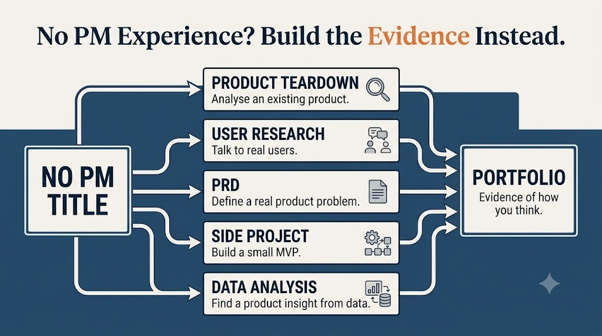
No PM title doesn't mean no evidence. Five things build the case for you.
An interviewer cares whether you can reason well, not whether it happened on someone's payroll. Start with one deep piece instead of five thin ones. Once you've built something, get feedback before publishing widely: The Product Folks community is a place to share a draft with people who've actually screened portfolios.
Once the portfolio is live, prepare for the conversation around it with TPF's PM interview questions.
At minimum, two or three solved case studies or teardowns that explain the reasoning behind each outcome, plus a short about section.
Use solved case studies, teardowns, a PRD, a small side project or a data analysis as your material. They're judged on reasoning quality, not on whether the work happened at a job. Start with one deep piece and get community feedback before calling it finished.
It depends on your level. It's close to essential when breaking in or switching with no title, useful for mid-level PMs, and optional for senior PMs whose track record carries the weight.
Two or three solved case studies, one teardown of a product you use, and ideally a small side project or PRD. Depth on a few pieces matters more than volume at this level.
Yes. TPF's template above gives you a structure for three case studies, your background, outcomes and learnings. Duplicate it into your own Notion and replace the placeholder sections.
Start with Archit Kaushal's Notion portfolio and Yashika Goel's Framer site, both listed above. For raw material to build your own, TPF's case studies and product teardowns cover many Indian companies, such as Swiggy, Zomato and Flipkart.
Keep reading

.avif)

.avif)
.avif)


.svg)
.svg)
