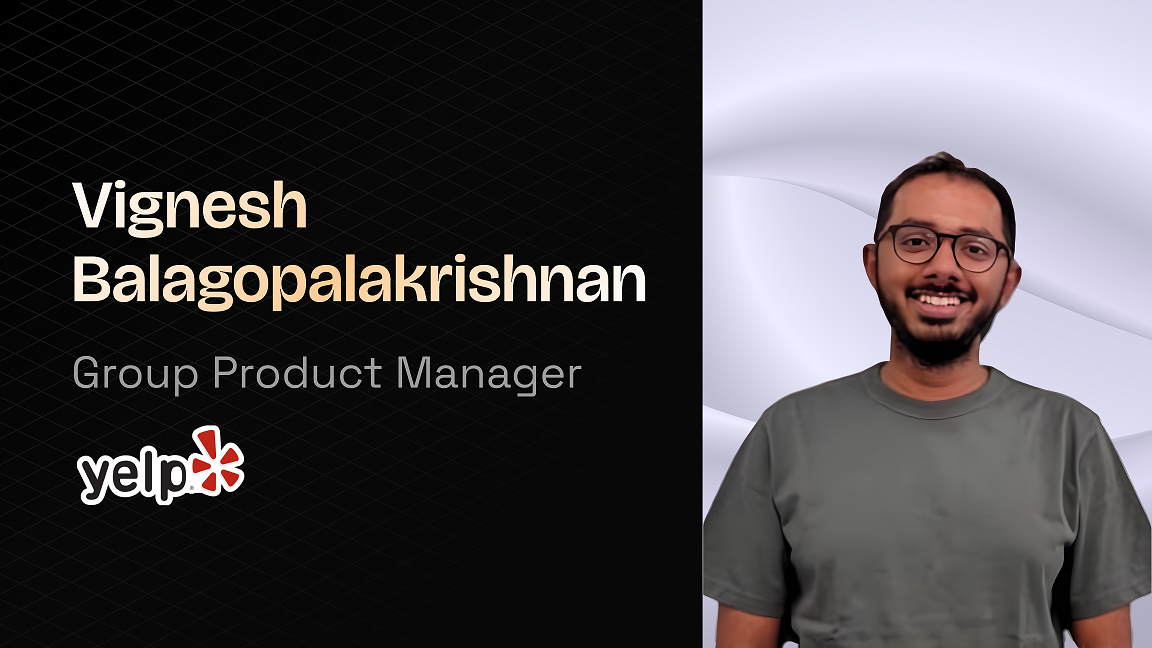
Vignesh Balagopalakrishnan(Viggy) is a Group Product Manager on the Ads team at Yelp, SF, California, USA. He joined as the first product lead for their off-yelp (retargeting) advertising products area. Through the last four years, he helped scale this area from a proof concept to a $40M+ business, and now manages a team of PMs.
Viggy also writes a newsletter Unpacked, where he publishes a weekly deep dive analysis of current tech topics, ranging from AI, product strategies of notable companies, and tech policy.
Let’s hear from Viggy on all PM things as well as his approach behind the newsletter Unpacked.
Yeah absolutely. It's funny as I think about it in hindsight - I studied CS in my undergrad, and for the longest time, I thought I'd love to go into CS research. After two summers of research internships, I knew that wasn't for me.
So, I started as a software developer with Adobe. Lot of fun writing real-life, production quality code. Couple of years in, I realized I loved tech but want to explore beyond engineering. This interesting, niche management consulting in Bangalore (Zinnov) came up - they primarily did business consulting for tech companies, and I started doing some product-adjacent work there (eg. looking into specific markets, product strategies, go-to-market approaches).
That was my first foray in PM-ing. And after my MBA, I started full-time at Yelp on the Ads team. Been an incredible time so far.
Great question. One of the things that makes early stage PM-ing a little more trickier is that there's limited data to work with, so you often have to make sense of subjective data + some amount of objective data.
It typically starts with some sort of a hypothesis - eg. when I starting with the Yelp Ad Network, our bet was that we would be able to build a product that reaches Yelp users outside the Yelp product in a way that's scalable and in a way it can drive performance from advertisers. And then, it's figuring out how to get early signals on whether you're able to prove (or disprove your hypothesis), and being brutally honest about what's working / not working.
The product building process I'd say depends on the maturity and type of product. I've had a good mix of products in my portfolio: one is now in 1->10 mode and very technical, second is in 0->1 and has a lot of go-to-market components.
I'm not a huge fan of PM frameworks to be totally honest because they try to prescribe force fitted solutions. My broad approach has been something along the lines of: discover what problem you are solving, define what would success look like if you solve it, and figure what you need to build / test to get confidence towards getting to that outcome (eg. experiments). PM-ing is a lot more of a common sense job that people appreciate it being.
Cracking the first PM role is the hardest, and it's always easier to transition within your company if possible. So I'd definitely try that path - build trust with people around, build trust with you PM / PM leaders in the company, see if they're let you take on a PM project or two. Prove you can crush that, and then ask for transitioning. It's worked well in other roles as well (eg. I've seen many analysts / people in BizOps roles transition into PM roles).
I'd also focus on finding roles where you can uniquely add value - for example, ex-engineers can add a lot of value in technical / platform / systems PM roles.
Yeah, just persevere. Cracking your first PM role is hard but it's a huge step function jump.
Yeah definitely. The PM market in the US is in a weird spot right now - lot of layoffs means there's incredible talent on the market, which makes is hard for new folks to crack into PM roles. I do think roles are opening up a lot more in the past few months, and it'll change a lot over the next year or two.
Factors I'd consider if you're thinking about your masters:
(1) is the thing that people don't do much and then regret it.
I think one of my earliest unexpected decisions was shifting from Adobe to Zinnov, which was a super niche management consulting firm. I knew nothing about consulting or business, so that was a weird jump at that point and I was nervous as hell to make it. In hindsight, it was one of the best career decisions I have made. I love small / medium companies because they throw so much stuff at you that you're grossly underqualified for, which can be a huge learning experience.
Good question re. services vs product based companies. I actually think that the lines are starting to blur a lot with more digitization, and services companies will be forced sooner or later to ramp up product investments. Which I think is good for the Indian market and the market for PMs also.
Coming to starting with business vs user / engagement related metrics -I don't think it's a hard and fast rule that you start with revenue metrics. I've seen several consumer product teams start with consumer metrics / user problems. I do think at some point of time, you need to triage how these consumer metrics tie into business value (eg. LTV of a user), because you'll need to make some sort of investment decision on how much you want to staff this area up.
Meaning if the team had X engineers and you had decide how much of their time goes in consumer engagement-driving work vs revenue-generating work, that's a real decision every company / org has to make. Definitely still makes sense to view consumer metrics separately as you think about the decision but I think the reason people tie it to revenue metrics is often to be able to do that objective comparison across projects.
Yeah I'd be happy to take a look at your case studies, feel free to reach out. I haven't looked at FinTech deeply but I've dug into a couple of fintech adjacent things as part of my writing on Unpacked(Click here for link).
Absolutely I think it's a bit of a choice based on which PM roles you take on. I wrote this piece sometime back about "systems" vs "feature" PMs. Systems PM for example is someone that might be build a news feed algorithm at Facebook, or spam detection in another marketplace. I think systems PMs role (I'd consider my products now probably 70% systems) are generally very technical, so you do end up going pretty deep into things like system designs
sorry missed adding the link (Click here).
Always great to meet a fellow Ads person. That's a great question. I do think there are problem spaces where domain expertise matters - I think AdTech is one of those, another example is SEO PMs. My team is about 50-50 in terms of previous adtech experience or not. Generally, I'm pretty open to hiring early career PMs that might not have domain expertise as long as they are coachable and willing to learn quickly. For senior roles, I do think domain expertise matters in ads but I'm cautious not to over index on it. Lot of good adtech people that don't make good PMs, and lot of solid PMs that could make great adtech PMs but don't have the domain experience, so it's a tricky balance.
I think I'd generally hire a strong PM without domain experience any day over an okay PM with domain experience.
Top of my list is usually:
Of course, glad to be here. Maybe a few pointers:
Also wanted to quickly mention a word about Unpacked - I've been publishing Unpacked for ~4 months now, and it's been a great way for me to apply my product experience + strengths to publish deep analyses (2000-3000 words) of current things happening in tech. The pieces usually span across Product Strategy analyses, AI, Tech Policy and just generally interesting companies. Feel free to check it out and subscribe the newsletter if the content interests you - https://thisisunpacked.substack.com/
Want to join the next conversation? We’ll be having another Product Chat soon, get your invite to our Slack community to get all the details. See you inside.



.avif)

.avif)
.avif)
.svg)

.svg)
