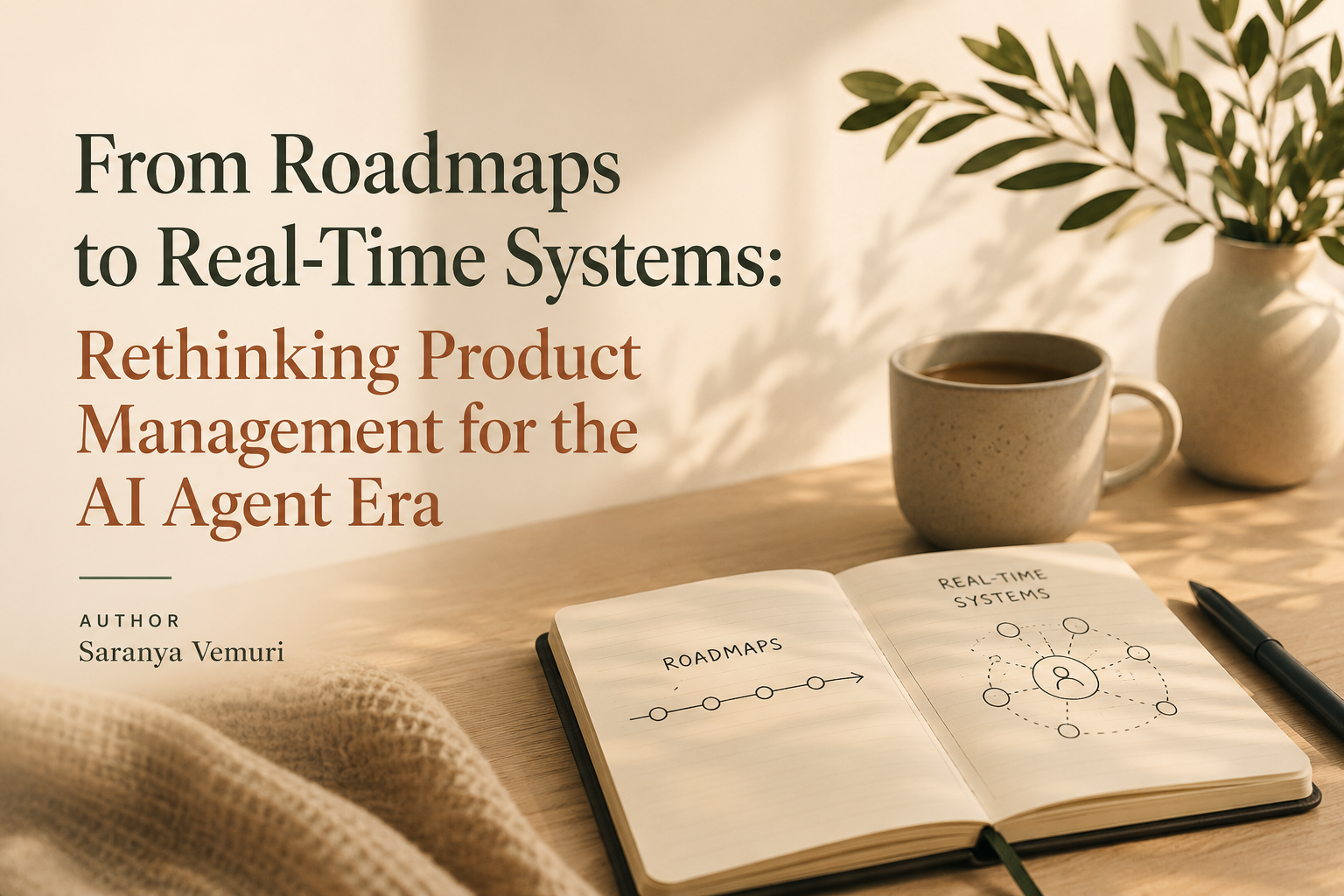
For most of my career, product management was built around a familiar rhythm. We defined strategy, translated it into roadmaps, aligned stakeholders, prioritized features, and executed against milestones.
Whether I was supporting large scale operational planning at Google, driving portfolio strategy for emerging hardware programs at Meta Reality Labs, or leading strategic planning initiatives at Amazon Devices, the roadmap was often the central artifact connecting vision to execution.
The assumption behind this model was simple: if we understood customer needs well enough, we could predict what to build, when to build it, and how to measure success.
AI native products are challenging that assumption.
As AI agents become increasingly capable of reasoning, acting, and adapting, products are beginning to behave less like static applications and more like dynamic systems. Instead of following predefined paths, users interact through intent. Instead of deterministic workflows, systems make decisions in real time. Instead of periodic updates, products continuously evolve through feedback loops.
The roadmap is no longer the center of gravity. The system itself becomes the product.
A few years ago, I found myself in a planning discussion that looked completely normal on the surface.
We were reviewing dependencies, milestones, resource allocation, and execution timelines. The conversation focused on sequencing initiatives and ensuring teams remained aligned around a predefined plan.
But as AI powered capabilities became part of the experience, something unexpected happened.
Users stopped interacting with the product the way we had designed it.
Instead of following carefully mapped workflows, they approached the system with goals. They expected it to interpret context, understand intent, and dynamically guide them toward outcomes. The paths we had spent months defining suddenly became less important than the system's ability to adapt in real time.
The most important questions shifted.
Instead of asking:
We started asking:
That experience fundamentally changed how I think about product management.
The challenge was no longer managing a roadmap. The challenge became designing behavior.
Traditional product development is largely feature centric.
We identify customer pain points, define requirements, build solutions, and measure adoption. The product evolves through a sequence of planned enhancements.
AI native products operate differently.
Users rarely think in terms of features. They think in terms of outcomes.
A customer doesn't want to navigate five screens to complete a task. They simply want the task completed. They don't care whether the answer comes from a workflow, a database, or an AI model. They care whether the system understands what they're trying to achieve.
The key question becomes:
Can the system accurately understand and respond to what the user is trying to accomplish?
This sounds subtle, but it fundamentally changes how we design experiences, define success metrics, and prioritize investments.
One of the most interesting shifts happening today is that products are increasingly powered by multiple AI agents working together.
A single user request may trigger:
The user sees one experience.
Behind the scenes, an entire ecosystem of systems coordinates to deliver it.
Historically, product managers focused on designing user flows.
Increasingly, we also need to design system flows.
That means answering questions like:
These are no longer purely technical decisions.
They are product decisions because they directly shape the customer experience.
Most products today are built around linear progression.
Step 1 leads to Step 2.
Step 2 leads to Step 3.
Success comes from reducing friction along that path.
Agentic systems don't always work this way.
They reason, revisit assumptions, gather additional information, and sometimes change direction entirely based on new context.
The workflow becomes less like a straight line and more like a network of possible paths.
As product managers, we are no longer designing every individual step.
We're designing the boundaries within which the system can safely make decisions.
The goal isn't to eliminate variability. The goal is to make variability reliable.
Perhaps the biggest implication for product management is how prioritization changes.
Traditionally, prioritization happened during quarterly planning cycles.
Teams evaluated opportunities, ranked initiatives, committed to a roadmap, and executed.
In AI native products, the environment changes too quickly for prioritization to remain a periodic exercise.
A capability that seemed secondary six months ago can suddenly become the most important workflow in the product.
As a result, prioritization becomes a continuous process rather than an annual or quarterly event.
The most successful teams won't be the ones with the most detailed plans. They'll be the teams that can learn, adapt, and reallocate focus faster than everyone else.
When I look at where product management is heading, I don't think the discipline is becoming less important.
I think it's becoming broader.
Product managers will still need:
But they'll also need to understand:
The role is expanding from managing products to managing adaptive systems.
Success increasingly depends on maintaining alignment across three constantly evolving layers:
When those layers stay aligned, the experience feels seamless.
When they drift apart, users immediately notice, even if every individual component appears to be functioning correctly.
Roadmaps are not disappearing.
Strategy is not disappearing.
Execution is certainly not disappearing.
But the center of gravity is shifting.
For decades, product management focused on defining what should be built and when.
In the age of AI agents, the more important question may be:
How should the system behave as it continuously learns, adapts, and evolves?
The future product manager won't simply be a roadmap owner.
They'll be designers of intelligent systems, balancing autonomy with trust, flexibility with reliability, and innovation with human needs.
The products we build are becoming less predictable, more adaptive, and increasingly capable of acting on behalf of users.
Our role is evolving alongside them.



.avif)

.avif)
Into the Future
.avif)

.svg)
.svg)
